Report sheet LN-03 · filed 27 Sept 2026
Clockwork: a time observatory with nothing upstream
Every figure is computed on your own machine. Against the US Naval Observatory, four of five sun times matched to the minute.
- Instrument
- labs.llc/clockwork/
- Shelf on labs.llc
- Studio & Tools · Earth
- Bench
- Local copy of the build-537 files
- Run
- 27 Sept 2026 · 20:00–20:03 UTC
- Controls
- timeanddate.com · Time.is · USNO
- Evidence
- Source lines in the build; timed reads
Aim
Clockwork computes everything in the browser: drawn world clocks for cities on a hand-kept register of 100, each card tinted by the sun’s real altitude there; sunrise, sunset and civil twilight; the moon’s true phase; a bench of up to ten stopwatches and countdowns; and an orrery of the eight planets that scrubs fifty years either way.
It is for people who keep several time zones in mind, for sky-watchers, and for anyone who needs a dependable timer in a tab. We checked the claim of zero network dependence and the accuracy of the sun arithmetic.
Method
Apparatus: what it reads, and where the work happens
No figure arrives over the network. City times use Intl.DateTimeFormat with IANA zone names — the browser’s own time-zone database. Sun times follow the NOAA solar equations, rise and set at a zenith of 90.833° and civil twilight at 96° (app.js 372–411); the card tint follows the sun’s current altitude (413–421). The moon is the true phase from the real sun–moon angle after Meeus (moon-core.js), not the mean month. The orrery uses Standish’s JPL approximate elements, with Kepler’s equation solved by Newton iteration (427–449).
Clocks tick on a self-correcting timeout aimed at each second boundary. Stopwatches compute elapsed time from a monotonic performance.now() stamp instead of counting ticks, so a throttled background tab returns with the right number (timers.js 1–25). A countdown exports as an .ics calendar event (685–699).
It reads
- The browser’s clock and IANA time-zone database
- NOAA solar position equations
- Meeus, Astronomical Algorithms, for the moon
- Standish (JPL), approximate Keplerian elements, Table 1
- A hand-kept register of 100 cities
Procedure
On 27 September 2026 (20:00–20:02 UTC) we searched every clockwork script for network calls, fetched the page and listed its scripts, counted the register, and ran the page’s own sun functions in JavaScriptCore for New York and for Longyearbyen at midsummer, comparing New York with the US Naval Observatory’s API.
Result
Fig. 11280 × 800
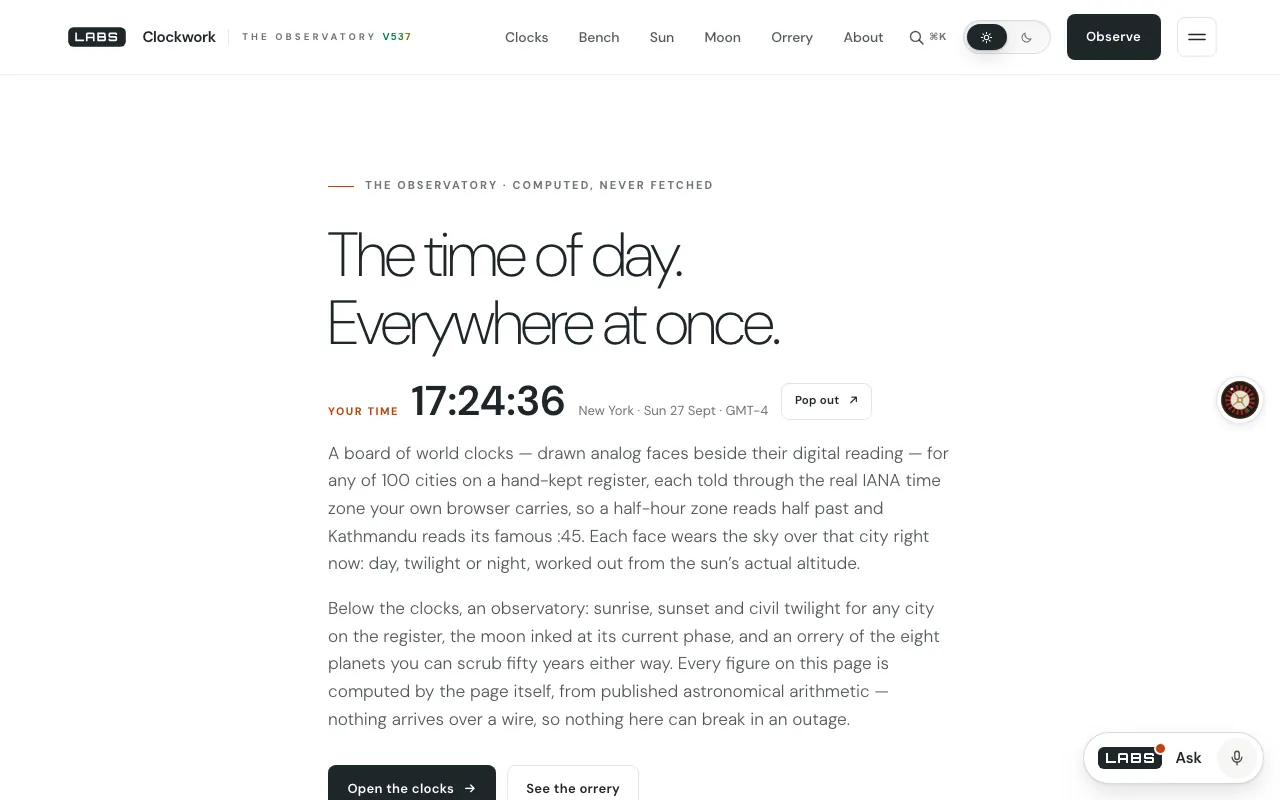
Fig. 2390 × 844
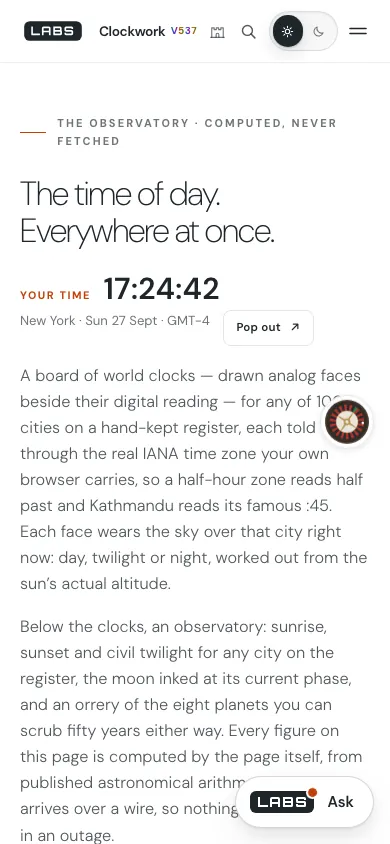
Table 1 · Run log, 27 September 2026
| No. | Reading | UTC | What came back |
|---|---|---|---|
| 1 | fetch( calls in the clockwork scripts | 0 in each of seven files | |
| 2 | Page | HTTP 200, 80,567 bytes; 20 script tags, including site-wide scripts and Google’s gtag.js | |
| 3 | City register | 100 cities | |
| 4 | New York sun, Clockwork against USNO | / | dawn 06:21 / 06:21 · rise 06:48 / 06:49 · noon 12:47 / 12:47 · set 18:45 / 18:45 · dusk 19:12 / 19:12 EDT |
| 5 | Longyearbyen, 21 June 2026 | returns ‘up’ — the sun never sets — rather than a false time |
Four of five events matched the Naval Observatory to the minute and sunrise came one minute early, inside the one-to-two-minute margin the code itself claims. The polar case gave the right kind of answer. ‘Zero requests’ holds for the figures, not the page, which still loads site scripts and Google’s analytics.
Discussion
Three controls: the same job done elsewhere on the web. Each was read on its own page on the date shown, and each is better than Clockwork at something.
timeanddate.com — Personal World Clock
Checked . Its page refused our fetch (HTTP 403), so its own help pages, found by search the same day, were used.
A world clock of your own locations, up to 50, each linked to a city page with weather, daylight saving, sunrise, sunset and moon phases; a separate Day and Night World Map shows the terminator and twilight for any moment.
Where it is better
- Any city by search.
- Fuller city pages with weather and daylight saving.
- A day-and-night map for any chosen moment.
Where Clockwork goes further
- Every figure computed in the page, with the algorithms named; 0 fetch calls measured.
- Up to ten drift-proof stopwatches and countdowns, with .ics export.
Time.is
Checked .
Exact official atomic-clock time for more than seven million locations, with sunrise, sunset and day length, world cities, time-zone pages and the day’s observances.
Where it is better
- Synchronises to an atomic reference; Clockwork trusts the device clock.
- Millions of places, not 100.
- Holidays and observances.
Where Clockwork goes further
- Civil twilight, the true moon and an orrery beside the clocks.
- Cards coloured by computed solar altitude.
US Naval Observatory — one-day Sun and Moon data
Checked .
Rise, set and transit for the Sun and Moon, civil twilight and lunar phase for any place, for dates from 1700 to 2100.
Where it is better
- Authoritative values, any coordinates, moonrise and moonset.
- A 1700–2100 range.
Where Clockwork goes further
- Matched to the minute on four of five New York events while running offline.
- Adds timers and an orrery.
Sources of error: where it falls short
- A fixed register of 100 cities: no arbitrary town or coordinate.
- No time-zone converter, meeting planner or daylight-saving dates per city.
- Planet elements are stated valid 1800–2050, yet the scrub runs to about 2076; the page admits the outer years lean on known drift.
- Approximate sun by design: ±1–2 minutes at mid-latitudes, worse near the poles.
- ‘Zero requests’ covers the figures only.
Conclusion
Finding4 of 5 New York sun events matched the US Naval Observatory to the minute; sunrise came one minute early.
Clockwork is built to depend on nobody — zones from the browser, the sun from NOAA’s equations, the moon from Meeus, the planets from JPL — and it names each. Then it does what makes a clock trustworthy: ticks re-aimed every second, stopwatches read from a monotonic stamp, a true moon, an orrery that admits it is not to scale. The price is a fixed list of 100 cities and trust in your device’s clock; for atomic time use Time.is, for any town timeanddate.com.