Report sheet LN-02 · filed 27 Sept 2026
Space: a launch board that will not fake a countdown
Only launches with a known time get a ticking clock. Our test confirmed the rule — and found the words for the rest one step off.
- Instrument
- labs.llc/space/
- Shelf on labs.llc
- Live Intelligence · Earth
- Bench
- Local copy of the build-537 files
- Run
- 27 Sept 2026 · 19:59–20:01 UTC
- Controls
- RocketLaunch.Live · Next Spaceflight
- Evidence
- Source lines in the build; timed reads
Aim
Space is a launch desk: the next fifteen rocket launches from Launch Library 2, each with vehicle, provider, pad and a status chip, and a countdown that runs only where the launch time is known to the hour or better. Beneath it the International Space Station crosses a drawn world map, trailed only by positions the page itself received.
It is for launch watchers who want the near-term manifest and the station’s whereabouts without an app or an account. We set out to test two claims: that it ticks only when the time is known, and that it reads its source politely.
Method
Apparatus: what it reads, and where the work happens
Everything runs in the browser (space/assets/js/app.js). One request fetches the library’s upcoming list (line 17); each launch is cut to ten fields and kept in localStorage (58–82). The page will not ask the library again within fifteen minutes and says so on its status line, with the time of the next permitted read, because the library rations free reads to about fifteen an hour (3–7, 84–98). Countdowns are local arithmetic once a second, never a request (175–186).
The station’s position comes from wheretheiss.at every five seconds; the trail is capped at one ninety-minute orbit of points actually polled (188–203). Coastlines are Natural Earth polygons bundled in world.js and drawn on a canvas. All three timers stop in a hidden tab (307–309). If the library fails after a good read, the board keeps the last list and says so (107–117).
It reads
- Launch Library 2 by The Space Devs, upcoming launches
- wheretheiss.at, satellite 25544 (the ISS)
- Natural Earth 1:110m land polygons, bundled in the page
Procedure
At 19:59:36 UTC on 27 September 2026 we fetched the page from the local build-537 copy, requested the exact library address the script uses and the station feed, and checked the library’s precision ids against the table in the script (line 136).
Result
Fig. 11280 × 800
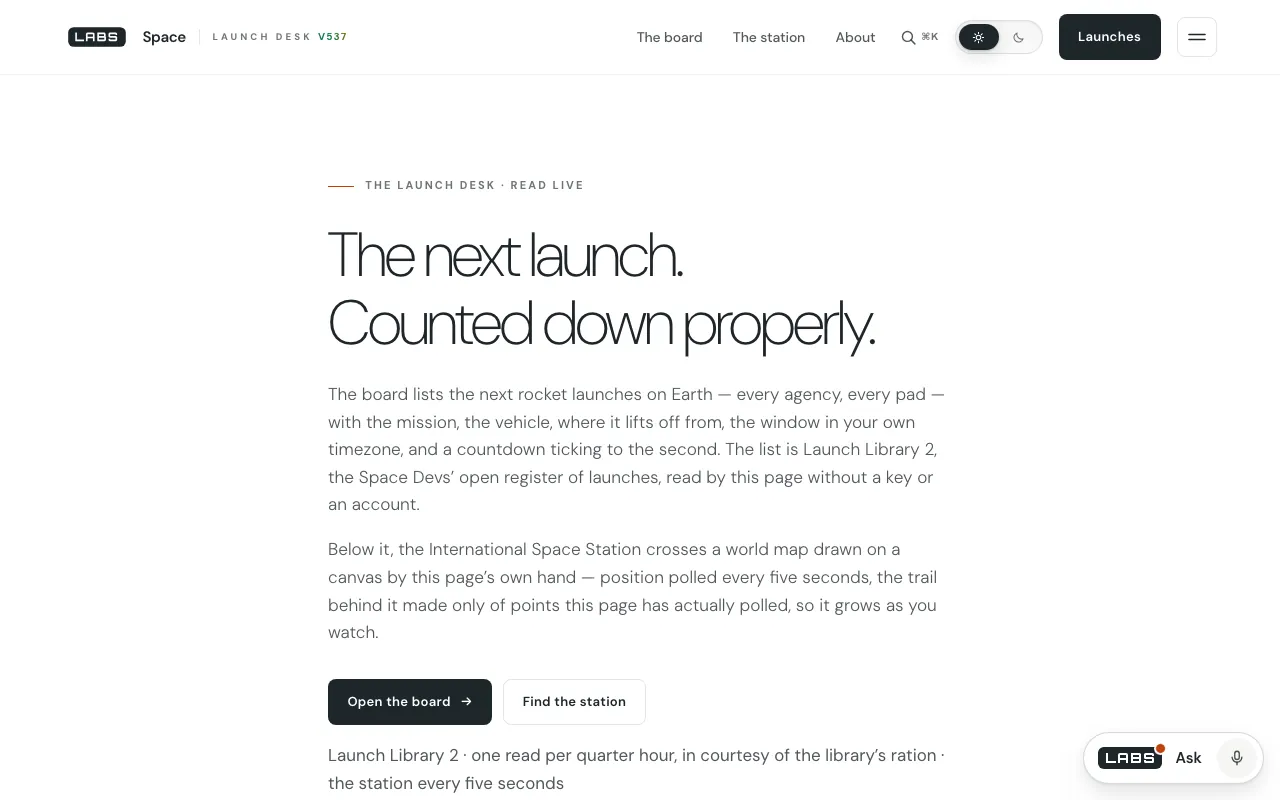
Fig. 2390 × 844
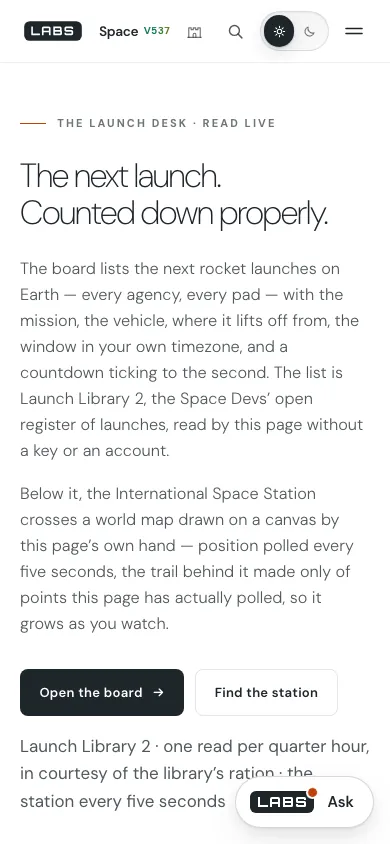
Table 1 · Run log, 27 September 2026
| No. | Reading | UTC | What came back |
|---|---|---|---|
| 1 | Desk page | HTTP 200, 51,729 bytes | |
| 2 | Launch list | HTTP 200, 177,463 bytes in 0.59 s; 15 of 367 upcoming; first row Starship, Starlink Group 31-1 (Flight 14), NET 28 Sept 12:15 UTC, Go | |
| 3 | Precision of the fifteen | 2 to the second, 6 to the minute, 2 to the day, 5 to the month — 8 would tick, 7 in words | |
| 4 | ISS position | 49.62°, −86.68°, 428.5 km, 27,574 km/h, in daylight | |
| 5 | Precision words against the library’s ids | Mismatch: the library says 5 = Day and 7 = Month; the script maps 5 to ‘month’ and 7 to ‘half’ |
The refusal to tick held: seven rows would have been given in words, not seconds. The words themselves were a step off. SR75 Flight 2, which the library places on a day, would read ‘known to the month’, and the five month rows ‘known to the half’.
Discussion
Two controls: the same job done elsewhere on the web. Each was read on its own page on the date shown, and each is better than Space at something.
RocketLaunch.Live
Checked .
A launch schedule with date and time, provider, vehicle, pad and location, a short mission description and booster identifiers; coarse dates appear as TBD, a quarter or a year. It offers calendar subscription, an API, a premium membership with notifications, and livestream pointers on launch day.
Where it is better
- Mission descriptions, booster numbers and livestreams.
- Calendar subscription and an API.
- A far longer schedule than fifteen rows.
Where Space goes further
- The station’s live position and a received-points trail on the same page; its schedule page showed no ISS tracker (app.js 188–214).
- Ticks only where the library states second, minute or hour precision, with no key and no membership tier (133–148).
Next Spaceflight
Checked .
An upcoming-launch list with date and time or NET, countdowns for imminent launches, rocket, provider, pad, landing zone and status; Upcoming and Previous views with filters; pages for rockets, reuse, Starship and locations; calendar and API options and a mobile app.
Where it is better
- Filters and past launches.
- Landing zones, booster reuse and pages per rocket and site.
- An app and calendar options.
Where Space goes further
- States on the page which library it reads, how often it may, whether you see the wire or the cache, and when the next read is allowed (84–98).
- An open tab costs the upstreams nothing: every timer checks for a hidden tab (307–309).
Sources of error: where it falls short
- Mislabelled precision: the table at app.js line 136 is one step behind Launch Library 2.3.0’s ids as measured, so day launches read ‘known to the month’ and month launches ‘known to the half’.
- Fifteen launches only: no filters by provider, site or vehicle, no past launches, mission text, livestreams or calendar export.
- Position only for the station: no visible-pass predictions (another labs desk, ORBIT, has those), and the trail starts empty on every visit.
- Up to fifteen minutes stale by design — which matters on launch day, when times slip.
Conclusion
Finding8 of 15 launches would tick and 7 get words — but the words were one step off the library’s ids.
Space reads its source the way the source asks, and it is right not to hang a ticking clock on a launch that has only a month. That discipline is the reason to use it. Our run also caught it out on the words it prints for those coarse dates, a fix of one table. For missions, streams and history, RocketLaunch.Live and Next Spaceflight carry far more.