Report sheet LN-05 · filed 27 Sept 2026
Tongues: 8,618 languages carried inside one page
The whole Glottolog register in the browser — fast and free, with the scholarly nuance left at the source.
- Instrument
- labs.llc/tongues/
- Shelf on labs.llc
- Live Intelligence · Words
- Bench
- Local copy of the build-537 files
- Run
- 27 Sept 2026 · 20:04–20:06 UTC
- Controls
- Glottolog · Ethnologue
- Evidence
- Source lines in the build; timed reads
Aim
Tongues is a register of the world’s languages that ships whole inside the page: every language-level entry of Glottolog 5.3 — 8,618 of them — searchable by name, ISO 639-3 code or glottocode, each with its family chain, macroarea, countries and endangerment on the six-step AES scale. Any family can be walked as a drawn tree, 8,304 languages sit on a world map inked by endangerment, and a daily ten-language guessing game is dealt from the same table.
It suits students, teachers, writers and enthusiasts. We wanted to see what the register holds, what it costs to load, and what it leaves out compared with its own source.
Method
Apparatus: what it reads, and where the work happens
Nothing is fetched at runtime (tongues/assets/js/app.js lines 1–3). The register is languages.js, built by tongues/tools/mklang.py from the Glottolog 5.3 CLDF release of 2 March 2026, with the CC-BY 4.0 citation in its header. Each row holds glottocode, name, ISO code, family path, macroarea, countries, coordinates and AES status (41–44).
Search ranks an exact glottocode or ISO match first, then names (65–93); the card shows the codes and the family chain (100–115); the tree is drawn on a canvas; the map colours every placed language by AES step (13–17). The daily game is a seeded shuffle keyed to the day, so everyone gets the same ten; it deals only spoken first languages with coordinates, countries and one macroarea, and takes decoys from the same macroarea (daily.js 1–20).
It reads
- Glottolog 5.3 CLDF release (Hammarström, Forkel, Haspelmath, Bank; MPI-EVA; CC-BY 4.0)
- ISO 3166-1 short country names
Procedure
On 27 September 2026 (20:04–20:05 UTC) we fetched the page and languages.js from the local build-537 copy, with and without gzip requested, parsed the register in Python, and looked up one entry — Manx — against Glottolog’s own page.
Result
Fig. 11280 × 800
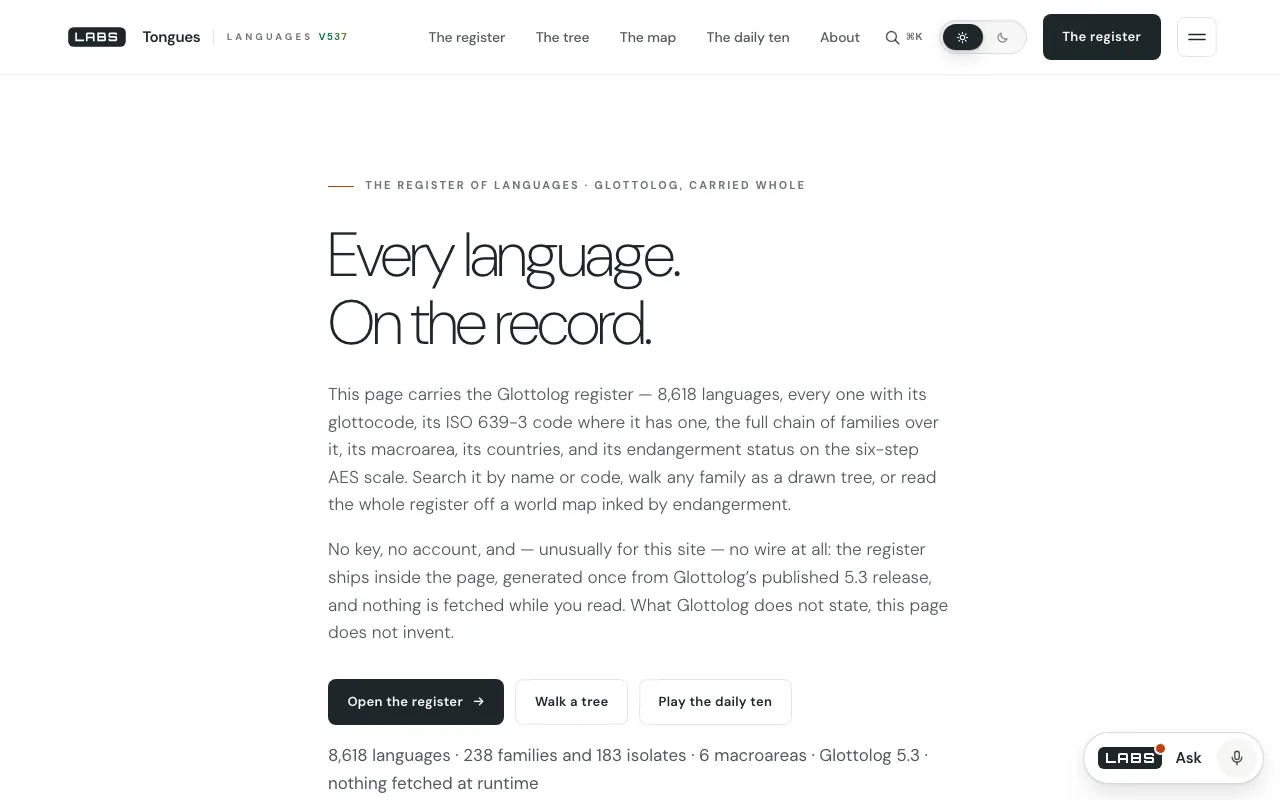
Fig. 2390 × 844
Table 1 · Run log, 27 September 2026
| No. | Reading | UTC | What came back |
|---|---|---|---|
| 1 | Page | HTTP 200, 53,343 bytes | |
| 2 | Register file | HTTP 200, 1,088,356 bytes — the same with gzip requested, on the local server | |
| 3 | Register contents | 8,618 rows; 7,859 with ISO codes; 8,304 with coordinates; 4,853 family and sub-group nodes | |
| 4 | AES status | 2,831 not endangered · 1,599 threatened · 1,828 shifting · 433 moribund · 312 nearly extinct · 1,239 extinct · 376 without status | |
| 5 | Manx | manx1243, ISO glv, GB and IM, AES 5 = extinct; Glottolog’s page adds an ‘Awakening’ note that Tongues does not carry |
Everything the page promises is in the file, including the extinct and nearly extinct languages that make the endangerment map worth reading. The same file is the cost: about a megabyte before the first search, and a status label parted from the note that explains it.
Discussion
Two controls: the same job done elsewhere on the web. Each was read on its own page on the date shown, and each is better than Tongues at something.
Glottolog
Checked .
The source catalogue: a page per languoid with its classification path, ISO code, AES status with its source and an explanatory note, countries and map, references, alternative names and links out. Its Manx page cited Campbell et al. 2022 for ‘extinct’, added an ‘Awakening’ note, and linked to WALS, Wikipedia, Wikidata, OLAC and the Endangered Languages Project.
Where it is better
- Every status sourced, with context notes where they matter.
- References, alternative names (Gaelg, Manx Gaelic) and links to other databases.
- Dialects and every level of the classification, not only languages.
Where Tongues goes further
- One instant box across name, ISO code and glottocode over the whole register, with the family drawn as a tree on the same page (app.js 65–93).
- A map of 8,304 languages coloured by endangerment, and a daily game from the same data.
Ethnologue
Checked . Its pages refused our fetch (HTTP 403), so its own FAQ and pages found by a search of ethnologue.com were used.
SIL’s reference catalogue of living languages, which rates each on the 13-point EGIDS scale; its 27th edition counts 7,168 living languages, and some material, statistics among it, sits behind an upgrade.
Where it is better
- A finer vitality scale: 13 EGIDS levels against six AES steps.
- A long-running reference with statistical summaries for subscribers.
Where Tongues goes further
- Free and complete in the page, from a CC-BY source credited in the data file.
- Extinct and sign languages as well as living ones: 1,239 entries are marked extinct.
Sources of error: where it falls short
- A snapshot of Glottolog 5.3 (March 2026): later corrections arrive only when the register is rebuilt.
- The AES label without its nuance: Manx reads ‘extinct’ with no mention of the awakening Glottolog records; nothing in the page or its scripts mentions revival.
- No speaker numbers, references, alternative names or links to other databases.
- About 1.09 MB of script up front, measured locally — heavy on a slow phone connection.
Conclusion
Finding8,618 languages in a 1.09 MB file; Manx shown as extinct without Glottolog’s awakening note.
Tongues makes an expert register feel like a pocket index: every language, three kinds of code, a tree and a map, and not one request once the page has arrived. It credits its source with version, date and licence. What it cannot carry is Glottolog’s scholarship — the sources, the notes, the names — so treat it as the fast way in, and follow the glottocode to Glottolog when the detail matters.